Comparison 07 of 10 · Weather & the world
Travel Disruptions, set beside FAA NAS Status and FlightAware
Every disrupted US airport from the FAA's own programme data, merged from two FAA documents and ranked worst first. The FAA's app goes further ahead in time; FlightAware goes down to your flight.
- Under test
- labs.llc/disruptions/
- Measured
- 27 Sep 2026, 20:00 UTC, local copy of build 537
- Rivals
- FAA NAS Status · FlightAware MiseryMap
- 1 labs.llc ahead
- 5 a rival ahead
- 1 level
- 2 unconfirmed
1What it is, and who it is for
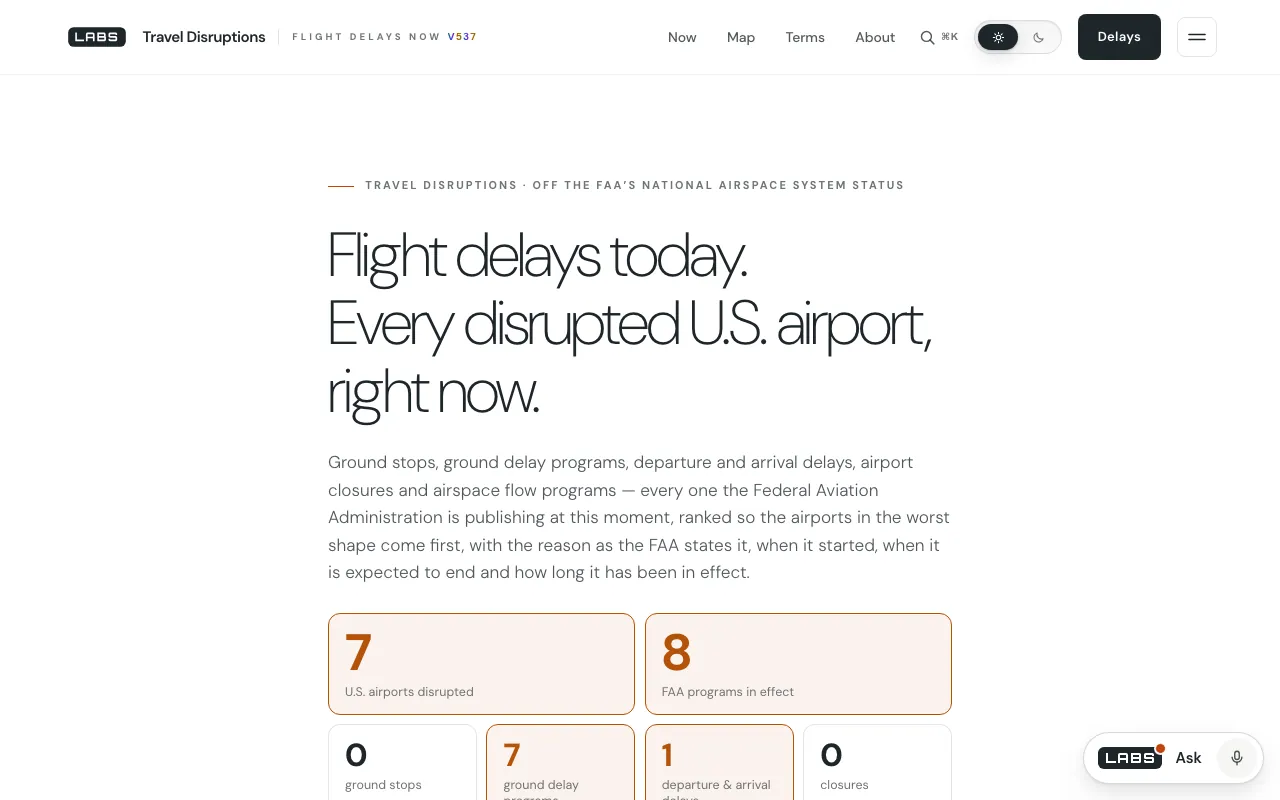
Travel Disruptions lists every US airport the Federal Aviation Administration is currently managing: ground stops, ground delay programmes with average and maximum delay, arrival and departure delays, closures and airspace flow programmes — ranked worst first, with the FAA's stated reason, the start, the expected end and how long each has been in effect, on a map and by state.
It is for travellers heading to or through a US airport today, and for anyone who wants the FAA's own programme data without an airline app. It counts airports and programmes, never flights, and says why.
2How it works
The FAA's status service sends no cross-origin header, so disruptions/nas-proxy.php reads two FAA documents on the page's behalf: the airport-events JSON, which carries each programme's start and end, delay minutes, advisory link and NOTAM text, and the older airport-status XML, which alone carries airspace flow programmes and the FAA's worded trends. It merges the two, keeps anything it does not recognise as raw text, caches for 120 seconds, and serves the last good copy marked stale if the FAA cannot be reached — while treating an empty answer as a genuinely quiet day (lines 1–45). It accepts no parameters.
The page re-reads every two minutes while the tab is visible, turns the FAA's worded durations (“1 hour and 42 minutes”) into minutes for sorting, and ranks programme types from ground stop down to restriction notice (app.js:9, 52–62). The FAA publishes programmes by airport, not how many flights each touches, and the page says it will not guess (index.html:515).
3The test
Measured on 27 September 2026 (UTC) through the local copy of build 537. The FAA's own app is a JavaScript application, so its features were checked from the FAA's published user guide.
| UTC | What | What came back |
|---|---|---|
| 20:00:05 | The page | HTTP 200, 52,189 bytes. |
| 20:00:15 | The relay | HTTP 200, 9,084 bytes, 0.13 s; both FAA documents read, FAA update time 19:59:32. 11 airports — AUS, BOS, EWR, JFK, LAX, LGA, ORD, PHL, SAN, SFO, TEB — with 13 programmes: 7 ground delay programmes, 3 ground stops, 3 restriction notices. |
| 20:00:15 | One entry in detail | Austin: ground stop for “runway construction”, 19:05 to 20:15 UTC, linked to the FAA advisory “ATCSCC ADVZY 095 AUS/ZHU 09/27/2026 CDM GROUND STOP”. |
| 20:00:15 | Relay given a parameter | HTTP 400: “This relay takes no parameters.” |
4The checklist
Nine checks. Travel Disruptions leads on presentation of the FAA's own data. The FAA's app leads on reach into the rest of the day, and FlightAware on the thing most travellers actually want to know — their flight.
- Yes: does it
- Partly: partly — read the note
- No: does not
- Not checked: not checked: no claim either way
- Not applicable: does not apply
| Check | labs.llc · under testTravel Disruptions | rivalFAA NAS Status | rivalFlightAware |
|---|---|---|---|
| Ground stops and delay programmes by airportLevel | Yes | Yes | Not checked1 |
| Ranked worst first, with time in effectUnconfirmed | Yes2 | Not checked | Not checked |
| Airspace flow programmes beside airport programmeslabs.llc ahead | Yes3 | Partly4 | Not checked |
| Forecast events for later in the dayRival ahead | No5 | Yes | Not checked |
| Command Center announcementsRival ahead | No | Yes | Not checked |
| Individual flights, delays and cancellationsRival ahead | No6 | Not checked | Yes |
| Airports outside the USRival ahead | No | Not checked | Yes |
| Link to the FAA advisory for each entryUnconfirmed | Yes | Not checked7 | Not checked |
| How far behind the FAARival ahead | up to ~4 min8 | updates every minute | Not checked |
- 1The MiseryMap shows delays and cancellations as outcomes; we did not confirm it shows FAA programmes.
- 2Programme type ranked, durations parsed from the FAA's wording (app.js:9, 52–62).
- 3Merged from the status XML into the same list (nas-proxy.php:12–29).
- 4Listed as Active En Route Events, a separate section in the user guide.
- 5The relay reads neither forecast events nor announcements.
- 6It counts programmes, not flights, and says so.
- 7Its user guide describes links to an advisories database; we did not confirm a link from each entry.
- 8A 120-second relay cache (nas-proxy.php:51) read by a two-minute poll (app.js:18), so a figure can be nearly four minutes old.
Does better
FAA NAS Status
- Forecast events for later in the day, and en route constraints.
- Command Center announcements and an advisories database.
- It is the authority, updated every minute according to its user guide.
Does better
FlightAware
- Individual flights: delays and cancellations by airline and airport.
- International airports.
- Its own ADS-B receivers and satellite data as well as air traffic control feeds from over 45 countries.
Goes further
Travel Disruptions
- Reads two FAA documents and merges them, so flow programmes and trends sit beside programme times; nothing unrecognised is dropped.
- Ranks every disrupted airport worst first and states how long each programme has run.
- Refuses to estimate flights the FAA does not count.
- Keeps the last good copy, marked stale, through an FAA outage.
5Where Travel Disruptions falls short
- US airports only; the FAA is its one source.
- Nothing about a particular flight. It cannot tell you whether yours is delayed or cancelled.
- No forecast events and no Command Center announcements, both of which the FAA's own app offers. Entries that are only deicing or only a runway configuration are dropped as not disruptions (nas-proxy.php:151).
- Up to about four minutes behind the FAA by design: a 120-second relay cache (nas-proxy.php:51) read by a page that polls every two minutes (app.js:18).
6The verdict, by the checklist
Choose Travel Disruptions for a ranked, readable view of what the FAA is doing at every US airport right now; choose FAA NAS Status for later today, and FlightAware for your own flight.
The matrix splits almost evenly by purpose. Travel Disruptions wins on reading the FAA well — two documents joined, ranked, timed, linked to the advisory — and refusing to invent the flight counts the FAA does not publish. It loses on scope: the FAA's app looks further ahead, and FlightAware looks at the aircraft. On test day it showed 11 airports and 13 programmes, each traceable to an FAA advisory.
Try Travel Disruptions on labs.llc