Comparison 08 of 10 · News
Pulse, set beside Pageviews Analysis and Listen to Wikipedia
Wikipedia's live edits across sixteen languages, a named firehose of every project, and the most-read list for any day since 2015 — with the small dates got right. One rival owns statistics; the other owns sound.
- Under test
- labs.llc/pulse/
- Measured
- 27 Sep 2026, 20:00–20:02 UTC, local copy of build 537
- 1 labs.llc ahead
- 4 a rival ahead
- 2 level
- 2 unconfirmed
1What it is, and who it is for
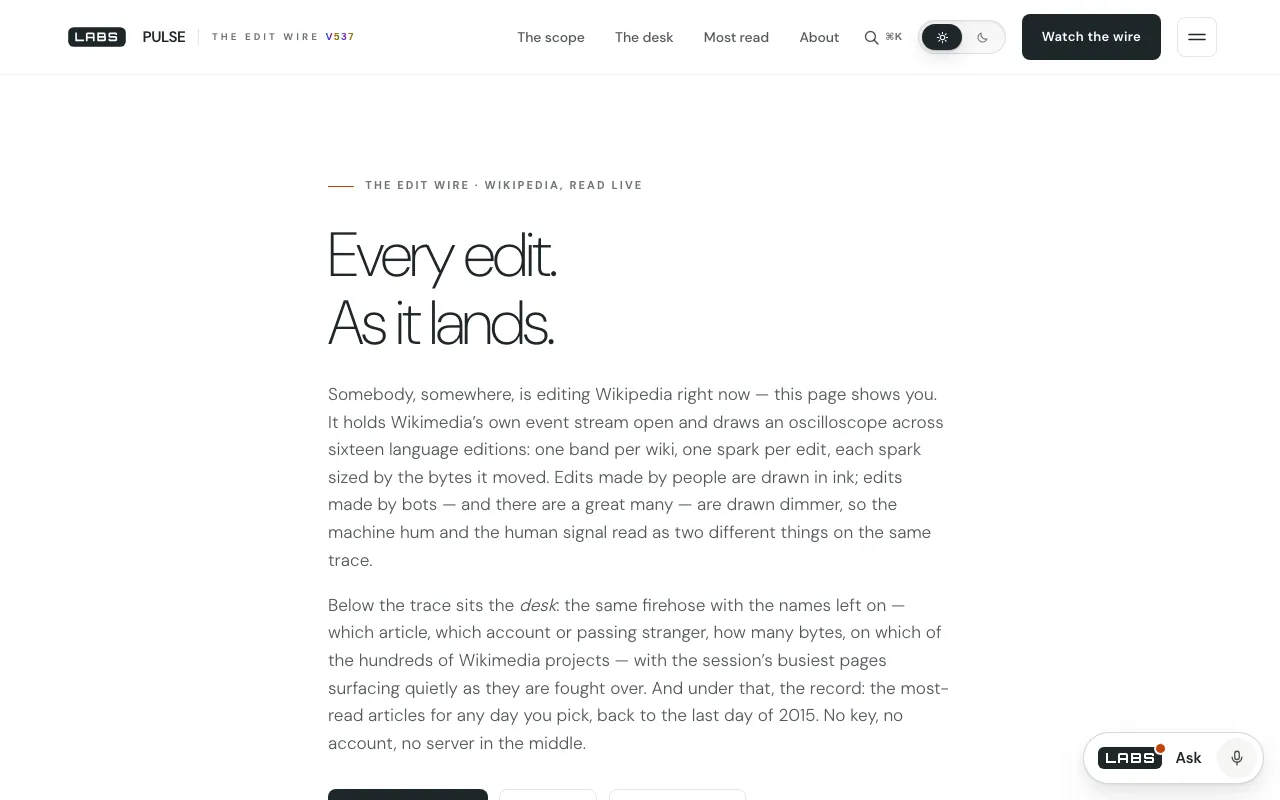
Pulse shows Wikipedia three ways. A rolling sixty-second oscilloscope draws edits across sixteen language editions, one band each, human edits in ink and bot edits dimmer. Below it, a desk names who edited what on every Wikimedia project. And a record lists the most-read English Wikipedia articles for any day back to 31 December 2015.
It is for students, journalists, editors, teachers and the plainly curious who want to see what the world is editing and reading, without installing anything or making an account.
2How it works
It runs entirely in the browser, with no relay. pulse/assets/js/app.js opens an EventSource on Wikimedia's public recent-changes stream and filters it in the page by wiki, because the stream offers no filter at the source (lines 2–9, 26, 169). Each edit is a spark whose height is its byte change on a log scale; bots are told apart by the wiki's own bot flag. The stream is closed when the tab is hidden and reopened on return, because “a hidden EventSource is a pile-up, not a pause” (8–10).
The record asks Wikimedia's Feed API for the following day, because a day's most-read list is published with the next day's feed, and it prints the date the feed stamps on its own list (11–15). The date picker stops at 31 December 2015, the earliest day found to answer by probing (15–18, 30). One revert test is shared by the scope and the desk, so the two cannot disagree about what a revert is (56–60). pulse/index.php only rewrites the preview tags for a ?day= link.
3The test
Measured on 27 September 2026 (UTC). The stream and the feed were read with curl exactly as the page reads them.
| UTC | What | What came back |
|---|---|---|
| 20:00:05 | The page | HTTP 200, 60,093 bytes. |
| 20:01:54 | A shared day, ?day=2026-08-26 | HTTP 200; preview title “The record for 26 August 2026 — Pulse | labs.llc”. |
| 20:02:03–13 | Ten seconds of the edit stream | 998,352 bytes; 635 edits from 35 wikis, 281 flagged bot. Only 116 (18%) were on the sixteen Wikipedias the scope draws — Commons alone sent 326. |
| 20:02:21 | Feed for 2026/09/27 | HTTP 200, 351,102 bytes; its most-read list is dated 26 September — 46 articles, led by Lizzie Borden (421,359 views). |
| 20:02:21 | The archive floor | 2015/12/31 answered 404 and 2016/01/01 answered 200, as the code's clamp assumes. |
4The checklist
Nine checks across three different ideas of “Wikipedia, live”. Pulse is the only one of the three that joins editing and reading on one page; each rival does its own half more deeply.
- Yes: does it
- Partly: partly — read the note
- No: does not
- Not checked: not checked: no claim either way
- Not applicable: does not apply
| Check | labs.llc · under testPulse | rivalPageviews Analysis | rivalListen to Wikipedia |
|---|---|---|---|
| Edits shown live as they happenLevel | Yes | No1 | Yes |
| Several language editions side by sidelabs.llc ahead | Yes2 | Partly3 | Partly4 |
| Bot activity marked apartLevel | Yes5 | Partly6 | Yes7 |
| Every Wikimedia project named in one feedUnconfirmed | Yes | Not applicable | Not checked |
| Most-read articles for a chosen dayRival ahead | Partly8 | Yes9 | Not checked |
| Any project, any date range, per-article trendsRival ahead | No | Yes | Not checked |
| DownloadsRival ahead | No | Yes10 | Not checked |
| SoundRival ahead | No | Not checked | Yes11 |
| Most-read list dated by the feed's own stampUnconfirmed | Yes12 | Not checked | Not applicable |
- 1A page-view suite; its tool list covers views, not edits.
- 2Sixteen bands on one time axis.
- 3Its suite includes Langviews, for views across language editions; we did not test it.
- 4You choose editions; we did not confirm they are drawn separately.
- 5The wiki's own bot flag.
- 6An agent filter — user, bot, spider — for views.
- 7Purple circles for bots.
- 8English Wikipedia only, one day at a time, as long as the feed's list (46 on the day).
- 9Topviews, any project.
- 10CSV, JSON or PNG.
- 11Bells for additions, plucked strings for removals.
- 12Asks for day+1; the 27 Sep feed carried 26 Sep's list.
Does better
Pageviews Analysis
- Eight tools covering any project and language, any date range and single articles.
- Platform and agent filters, and false positives can be removed in Topviews.
- Downloads as CSV, JSON or PNG.
Does better
Listen to Wikipedia
- You can hear the edit stream: pitch follows the size of the edit.
- New users are welcomed with a link to their talk page.
- Filtering by hashtag.
Goes further
Pulse
- Joins live editing with the reading record on one page.
- Dates the most-read list correctly by asking for the next day's feed — reproduced here.
- Clamps the calendar to an archive floor it probed, and the probe still holds.
- Closes the stream when you look away, instead of letting events pile up.
5Where Pulse falls short
- Heavy on the connection. The public stream cannot be filtered at the source, so the page takes in about a megabyte every ten seconds to draw the fifth of it that belongs to its sixteen editions.
- The most-read record is English Wikipedia only, one day at a time, and only as long as the feed's own list. Pageviews Analysis covers other projects, date ranges and single articles, with downloads.
- No sound, no saved history of the live trace, and no export from the scope or the desk.
- The estate's register still says “twelve languages” (assets/js/portfolio-data.js:890) where the page and code show sixteen.
6The verdict, by the checklist
Choose Pulse to watch Wikipedia being edited and read in one place with the dates right; choose Pageviews Analysis for numbers you can download, and Listen to Wikipedia to hear it.
Pulse wins the rows that ask for breadth at a glance — sixteen editions on one axis, every project on one wire — and loses the rows that ask for depth, where Pageviews Analysis is the proper instrument. Its extra lengths are small and exact: a list dated by the feed's own stamp, a floor found by probing. The bandwidth it spends to get there is the price.
Try Pulse on labs.llc