Comparison 06 of 10 · Earth
Hurricane, set beside the NHC, Tropical Tidbits and Zoom Earth
A storm board that copies the National Hurricane Center's figures and adds nothing of its own. It matched the Center to the last mile per hour; all three rivals show far more.
- Under test
- labs.llc/hurricane/
- Measured
- 27 Sep 2026, 20:00 UTC, local copy of build 537
- 1 labs.llc ahead
- 5 a rival ahead
- 1 level
- 1 unconfirmed
1What it is, and who it is for
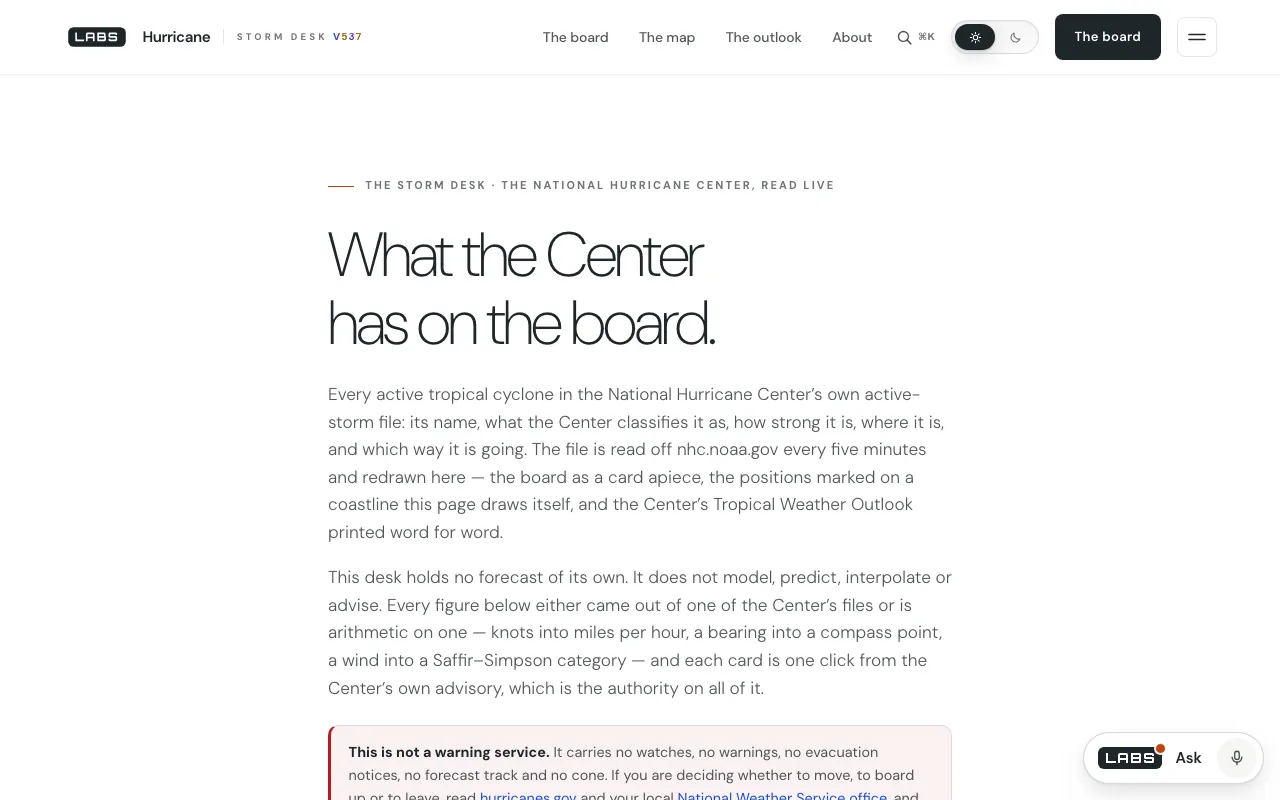
Hurricane is a board of every active tropical cyclone in the US National Hurricane Center's active-storm file: wind in knots and miles per hour, pressure, position, movement and a Saffir–Simpson category, marked on a basin map the page draws itself, with the Center's Atlantic and eastern Pacific outlooks printed word for word. It can also send a push notice when a new system appears.
It is for people in or watching the Atlantic and the eastern and central Pacific who want the Center's current figures on one clean board, with a link to the official advisory, and no commentary. The page says outright that it is not a warning service.
2How it works
A browser cannot read nhc.noaa.gov directly because it sends no cross-origin header, so hurricane/nhc-proxy.php relays exactly three files by key — CurrentStorms.json, TWOAT.xml and TWOEP.xml — with a five-minute cache that matches the Center's own. The JSON is decoded, shape-checked and re-encoded; the outlooks pass through untouched (lines 1–35).
The page re-reads the storm file every five minutes and the outlooks every fifteen while the tab is visible. It holds no forecast: every figure is a copy or a conversion. Knots become miles per hour by the Center's own rule — multiply by 1.15078 and round to the nearest five, so 110 knots is 126.6 and prints as 125 (app.js:152–158). The basin comes from the storm's id, the coastline is Natural Earth at 1:110m, and alerts.php stores Web Push subscriptions for a sender that fires an empty notice when a new system appears.
3The test
Relay requests went to the local copy of build 537; the Center's page was fetched about eight minutes later to compare. 27 September 2026, UTC.
| UTC | What | What came back |
|---|---|---|
| 20:00:14 | Active-storm file via the relay | HTTP 200, 18,642 bytes, 0.21 s, cache miss. Five systems: Fay (depression, 30 kt), Odalys (storm, 50 kt), Polo (hurricane, 110 kt), Eighteen-E (depression, 30 kt), Nolo (hurricane, 90 kt). |
| 20:00:14 | Outlooks via the relay | Atlantic: 2,604 bytes, the Center's text stamped 19:57:36 UTC. Eastern Pacific: 2,977 bytes. |
| 20:00:15 | Relay asked for an unknown feed | HTTP 400: “feed must be one of: storms, twoat, twoep”. |
| ≈20:08 | Agreement with nhc.noaa.gov | The Center listed Polo 125 mph, Nolo 105, Odalys 60, Fay 35 and Eighteen-E 35. The desk's rule applied to the relay's knots gives the same five figures. |
4The checklist
Eight checks. Hurricane wins one row — keeping model output off the page — which some readers will count as a loss. Everywhere else the rivals do more, which is the point of this comparison.
- Yes: does it
- Partly: partly — read the note
- No: does not
- Not checked: not checked: no claim either way
- Not applicable: does not apply
| Check | labs.llc · under testHurricane | rivalNHC | rivalTropical Tidbits | rivalZoom Earth |
|---|---|---|---|---|
| Wind in mph exactly as the advisory rounds itLevel | Yes1 | Yes | Not checked | Not checked |
| Official forecast cone and trackRival ahead | No2 | Yes | Not checked3 | Not checked4 |
| Outlook text for every NHC basinRival ahead | Partly5 | Yes | Not checked | Not checked |
| Storms beyond the NHC's basinsRival ahead | No | No6 | Yes7 | Yes8 |
| Satellite imageryRival ahead | No9 | Not checked | Yes10 | Yes |
| Keeps model guidance off the pagelabs.llc ahead | Yes | Not checked | No11 | No12 |
| Push notice for a new system, no accountUnconfirmed | Yes | Not checked | Not checked | Not checked |
| Newest name for system Eighteen-ERival ahead | Eighteen-E | Eighteen-E | 18E RACHEL | Not checked |
- 1All five systems matched on the day.
- 2By design: no forecast of any kind (app.js:12–19).
- 3It shows model tracks and ensemble plots, which are not the official forecast; whether it also carries the official cone was not checked.
- 4Model forecast layers appear; an official cone was not confirmed.
- 5Atlantic and eastern Pacific only; no central Pacific outlook while central Pacific Hurricane Nolo was active.
- 6Its page listed five systems, all in its three basins, while Tropical Tidbits listed 25W Surigae.
- 725W Surigae and several invests listed.
- 8Tracks built with JTWC as well as NHC data.
- 9A drawn Natural Earth coastline, no imagery.
- 10Infrared loops.
- 11GFS and EPS ensembles and model intensity guidance — its purpose.
- 12ICON and GFS model layers.
Does better
National Hurricane Center
- The official guidance: cones, tracks, wind-speed probabilities and key messages.
- Outlooks for the central Pacific as well.
- Key messages in two languages.
Does better
Tropical Tidbits
- Worldwide basins and invests, updated every 15 minutes from ATCF.
- Model tracks, ensembles and intensity guidance.
- Satellite loops and reconnaissance data.
Does better
Zoom Earth
- Satellite imagery under the storms.
- Global coverage through JTWC as well as NHC.
- Wind, temperature and pressure forecast layers.
Goes further
Hurricane
- Converts knots with the Center's own round-to-five rule, so every mph figure matched the advisory on the day.
- Passes the outlook text through verbatim and re-validates the storm file (nhc-proxy.php:24–29).
- The relay answers for three named files and refuses anything else.
- A push notice that carries no figure, so the numbers are always read on the page (index.html:620–621).
5Where Hurricane falls short
- No forecast track or cone, by design. The Center offers interactive cones and probabilities; Tropical Tidbits shows model tracks.
- Atlantic and eastern Pacific outlooks only. A central Pacific hurricane, Nolo, was active during the test and the desk printed no outlook for its basin.
- Nothing outside the NHC's basins, and no invests. Tropical Tidbits listed 25W Surigae and several invests; Zoom Earth draws on JTWC too.
- It can trail the forecasters' systems: at about 20:09 Tropical Tidbits already listed “18E RACHEL” while the Center's file, read at 20:00, still said Eighteen-E.
6The verdict, by the checklist
Choose Hurricane for the Center's current numbers on one uncluttered board, matched to the advisory; go to the NHC for decisions, and Tropical Tidbits or Zoom Earth for models, imagery and the rest of the world.
This is one of the matrices where labs.llc wins least, and rightly: the Center is the authority and the other two are far richer. What Hurricane offers is restraint that can be checked — the same numbers as the advisory, to the mile per hour, and nothing a reader could mistake for a forecast. For a quick look that will not mislead, it earns its place; for anything more, the rivals are the better tools.
Try Hurricane on labs.llc