Comparison 03 of 10 · Internet
Drop watch, set beside ExpiredDomains.net and Dynadot
A watch list for taken domain names that asks each name's own registry where it stands and dates the release window by the published rule. One rival finds drops; the other catches them.
- Under test
- labs.llc/domains/dropwatch/
- Measured
- 27 Sep 2026, 20:00–20:01 UTC, local copy of build 537
- Rivals
- ExpiredDomains.net · Dynadot Backorders
- 1 labs.llc ahead
- 2 a rival ahead
- 1 level
- 4 unconfirmed
1What it is, and who it is for
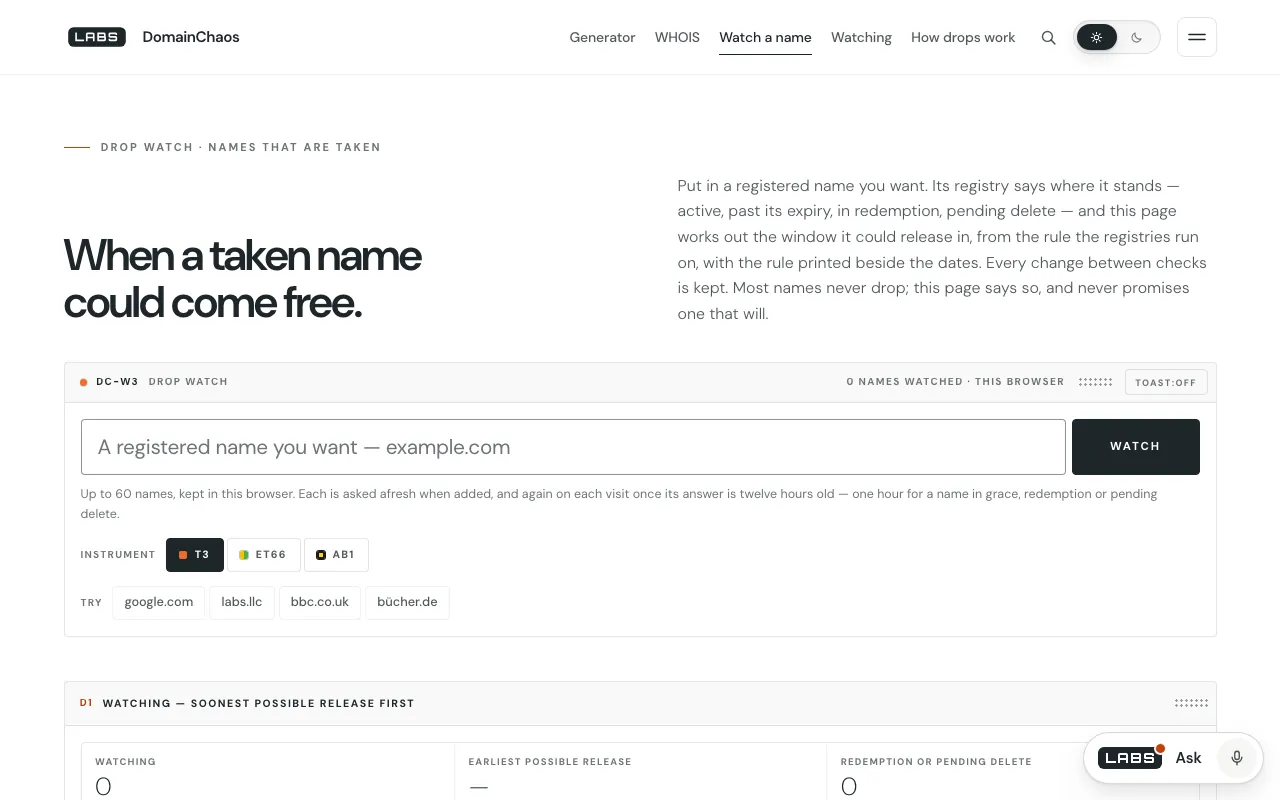
Drop watch is one of ten instruments on the labs.llc domains desk. You give it registered names you want; for each, it asks the registry where the name stands — active, past expiry, in redemption, pending delete — works out the window in which it could be released, prints the rule beside the dates, and keeps every change between checks. The list exports as a calendar file with reminders, as CSV and as JSON.
It is for founders, brand owners and domain investors waiting on one specific taken name who want to know, before paying anybody to back-order it, whether and when it could plausibly come free. Its own page is blunt that most names never drop.
2How it works
The list lives in your browser under the key dc.dropwatch.v1, up to sixty names. Each name goes, one at a time, to the desk's same-origin WHOIS engine at /domains/whois/api.php in lite mode. That engine reads the registry's RDAP record, found through IANA's RDAP bootstrap, plus IANA's WHOIS for the ending and a DNS lookup over HTTPS from dns.google. If the engine cannot be reached, the page asks IANA, the registry and DNS over HTTPS directly from the browser and marks the report partial (whois-core.js:1672–1707, 2080).
The phase comes from the registry's EPP status codes first — pendingDelete, redemptionPeriod, autoRenewPeriod — and from dates second (dc-watch.js:258–264). For ICANN-contracted generic endings the release window is expiry plus 35 to 80 days (grace 0–45, redemption 30, pending delete 5; lines 190–212, 315, 325); a name already in pending delete is dated five days from its last change (283). Country-code endings get no dates, because their registries publish no timetable (267). Names are re-asked when their answer is twelve hours old, or one hour old in grace, redemption or pending delete (821).
3The test
All requests went to the local copy of build 537 on 27 September 2026; the engine then asked the real registries. Times UTC.
| UTC | What | What came back |
|---|---|---|
| 20:00:05 | The page | HTTP 200, 70,851 bytes. |
| 20:01:11 | Engine report for example.com | HTTP 200, 9,252 bytes of JSON from the engine's cache (fetched 19:59:48, 83 s old). Read from rdap.verisign.com (HTTP 200, 84 ms), whois.iana.org (124 ms) and dns.google (63 ms): created 1995-08-14, expires 2027-08-13, three client…Prohibited status codes. |
| 20:01:24 | Engine report for z34.org | HTTP 200, 4,816 bytes, 129 ms, uncached. The .org registry's RDAP answered 404. The report says the contracted registry is authoritative that nobody holds it — and that “Not registered is not the same as for sale”. |
| 20:01:13 | The list of endings | HTTP 200: 1,438 top-level domains, 1,200 of them with an RDAP service, updated 19:58:35 the same day. |
4The checklist
Eight checks. Drop watch leads where the question is “what will happen to this one name, and why?”. The rivals lead where the question is “what can I get, and can you get it for me?”.
- Yes: does it
- Partly: partly — read the note
- No: does not
- Not checked: not checked: no claim either way
- Not applicable: does not apply
| Check | labs.llc · under testDrop watch | rivalExpiredDomains.net | rivalDynadot Backorders |
|---|---|---|---|
| Watches a specific name you already wantLevel | Yes | Partly1 | Yes |
| Reads that name's own registry record liveUnconfirmed | Yes2 | Not checked | Not checked |
| Dates the release window before the name dropslabs.llc ahead | Yes3 | Partly4 | Partly5 |
| Prints the rule behind each dateUnconfirmed | Yes6 | Not checked | Not checked |
| Finds dropping names you had not thought ofRival ahead | No | Yes7 | Yes |
| Tries to register the name at the dropRival ahead | No | Not checked | Yes8 |
| Alerts that leave the pageUnconfirmed | Partly9 | Not checked | Not checked |
| Exports the watch listUnconfirmed | Yes10 | Not checked | Not checked |
- 1A watchlist to follow expired domains after they dropped, per its front page.
- 2Measured: rdap.verisign.com for example.com, rdap.publicinterestregistry.org for z34.org.
- 335–80 days after expiry for generic endings (dc-watch.js:190–212).
- 4Pending-delete lists, “updated every minute” — names already in the final stage.
- 5A browsable list of expiring names with countdowns.
- 6Rule strings at dc-watch.js:283, 301, 325.
- 7676 endings, 30 domain lists.
- 8“You only pay if we successfully catch the domain.”
- 9Only the calendar file's reminders, 60, 30 and 7 days before (dc-watch.js:1278); no push or email.
- 10.ics with reminders, CSV and JSON (dc-watch.js:378–392, 447–456).
Does better
ExpiredDomains.net
- Discovery: browse and filter thousands of dropping names across 676 endings.
- SEO signals for each name — backlinks and an Archive.org birth date.
- Auction and marketplace lists beside the drops.
Does better
Dynadot Backorders
- Actually tries to register the name the moment it is released.
- You pay only on success; competing back-orders go to an auction.
- A browsable list of expiring names with countdown timers.
Goes further
Drop watch
- Asks each name's registry directly through RDAP, and the engine's report names the registry that answered.
- Lets the registry's status code outrank the calendar, and anchors pending delete on the record's own last-changed date (dc-watch.js:200–212).
- Refuses to call a missing record “available” or let a failed check overwrite a good one (lines 12–18).
- Draws no invented dates for country-code endings (267).
- Its own worked example, z34.org, was dated for 11 September; on 27 September its registry answered 404.
5Where Drop watch falls short
- It watches and dates; it cannot catch. When a name drops, registering it first is up to you or a service such as Dynadot's.
- The list lives in one browser, and nothing alerts you except the calendar file's reminders.
- Sixty names at most, and names are only re-checked while the page is open.
- No dates at all for country-code endings — honest, but there is nothing to plan around for a .co.uk or a .de.
- It does not discover drops. You must already know the name; ExpiredDomains.net publishes the lists.
6The verdict, by the checklist
Choose Drop watch to learn, from the registry, whether one name you want could come free and when; choose ExpiredDomains.net to find names, and Dynadot to try to catch one.
The three are not substitutes; they are stages. Drop watch is the step before spending money: it reads the registry, shows its arithmetic and says “could”, never “will”. It wins the rows about the evidence behind a date and loses every row about acquiring a name, which is the part the rivals exist for.
Try Drop watch on labs.llc